

At Ioannis Raptis’ clinic, endocrine disorders are managed in accordance with the guidelines of the “Frankfurter Hormonschule” and the International Society of Gynecological Endocrinology – ISGE.
Follow Us

Menopause refers to the permanent cessation of menstruation, resulting from the natural and irreversible decline in the production of estrogen and progesterone by the ovaries. The absence of menstruation for a full year establishes the clinical diagnosis of menopause.
The age of menopause usually ranges between 45 and 55 years. However, when ovarian reserves are depleted prematurely and menstruation ceases before the age of 40, this is referred to as premature menopause, which affects approximately 1% of women.
The period preceding the definitive cessation of menstruation, during which hormonal changes and related characteristic symptoms such as menstrual irregularities and hot flashes occur, is called the climacteric and typically lasts 1–2 years.
In the following article, we help women better understand the natural hormonal transition that occurs during menopause and how to best manage potential symptoms.
Contents:
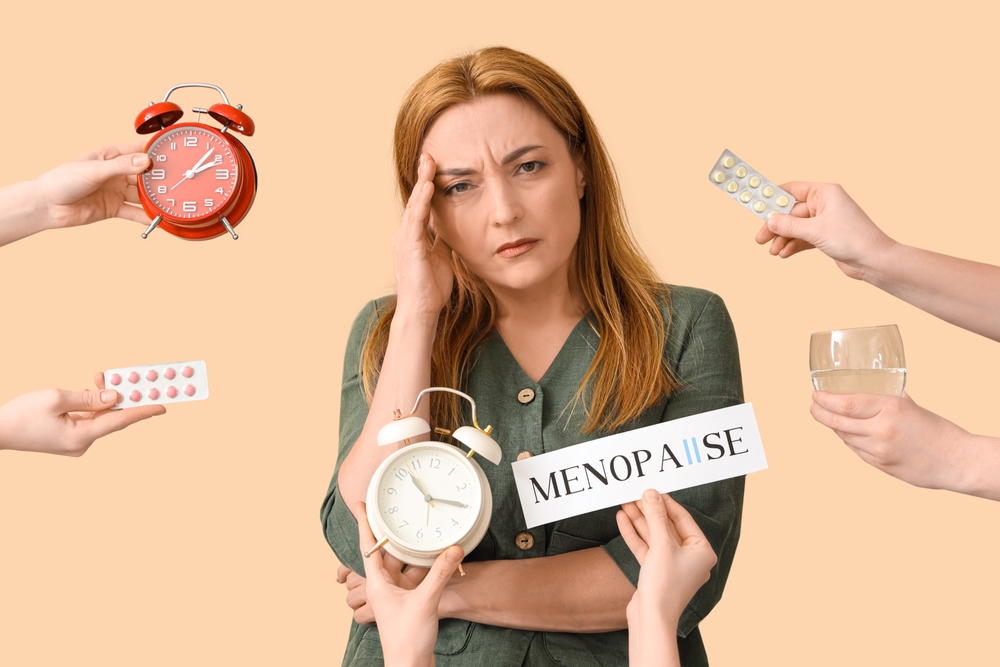
Menopause is the permanent cessation of menstruation, resulting from the irreversible depletion of ovarian reserves.
There are two ways to diagnose menopause. The first is through a simple blood test that confirms ovarian insufficiency. The second is clinical and refers to the absence of menstruation for a period of 12 months.
The term menopause refers to a specific point in time, namely the end of the last menstrual period, which can only be determined retrospectively.
For this reason, and in order to study all the changes associated with the gradual decline in hormone production by the ovaries, we use the concept of the climacteric.
This term is broader and includes the period during which the gradual depletion of ovarian reserves is observed, preceding the definitive cessation of menstruation..
The main symptoms of menopause include hot flashes and night sweats, vaginal dryness, and sleep and mood disturbances. These symptoms are not the same for all women, and even in the same patient, variations in symptoms may be observed over time.
Hot flashes are a symptom that significantly affects patients, not only because of their intensity and frequency, but also because in many cases they may persist for several years after menopause.
Vaginal dryness in many cases significantly impacts women’s sexual life, with a direct effect on their psychology and mood. In some cases, symptoms are not limited to sexual intercourse but may be continuous, presenting as itching or burning.

Changes in mood and psychology vary from woman to woman and are usually multifactorial. They are not exclusively due to hormonal deficiency but also depend on the woman’s temperament and her attitude toward the natural changes that take place.
The most common symptoms encountered include anxiety, difficulty concentrating, irritability, depressive mood, and mood swings.
In addition to the symptoms that are easily perceived, there are also physical changes in the body related to hormonal deficiency.
These mainly include accelerated reduction in bone density, redistribution of body fat primarily to the abdominal area, increased blood lipid levels, and impairment of vascular function.
The belief that hysterectomy leads to menopause is incorrect. When a woman who is still menstruating undergoes removal of the uterus, she no longer has menstrual bleeding. This occurs because the organ that bleeds in response to the hormonal cycle of the ovaries is removed.
However, this does not mean that blood accumulates somewhere, nor that the patient enters menopause. This depends on whether the ovaries, which produce female hormones, are also removed along with the uterus.
In many cases, a patient may undergo hysterectomy before menopause without removal of the ovaries. This may occur, for example, in cases of benign gynecological conditions such as uterine fibroids.
In this situation, when menopause eventually occurs, it is detected only through laboratory findings or indirectly through the symptoms described above.
In contrast, menopause may be surgically induced when the gynecologist performs removal of the ovaries, with or without removal of the uterus.
In this case, the sudden cessation of female hormone production is referred to as surgical menopause and is usually associated with more intense symptoms.
Finally, it is worth noting that after the cessation of ovarian function, continuation of annual preventive gynecological examinations, including transvaginal ultrasound, is recommended, as ovarian cystic formations may also occur during menopause.

The management of menopause symptoms plays a decisive role in maintaining women’s quality of life, as this period usually coincides with a productive phase in a woman’s life.
There are various natural approaches aimed at managing the above symptoms and alleviating the problems that arise.
Exercise is perhaps the most important step in managing many consequences of menopause.
On the one hand, it acts as a counterbalance to factors that negatively affect the woman’s cardiovascular system and are associated with menopause (increased blood lipids, impaired vascular function, reduced metabolism).
At the same time, physical activity strengthens bone health, significantly slowing the reduction in bone density and acting preventively against the development of osteoporosis.
Finally, we should not overlook the proven positive effect of exercise on a woman’s psychological well-being, as it gives her an active role in promoting her own health.
The important role of nutrition in maintaining overall health is undeniable. However, to date, there is no scientific evidence supporting the direct positive effect of specific foods on menopause symptoms.
In any case, just like exercise, a balanced diet (rich in fruits and vegetables, preference for white meat, avoidance of processed foods, and reduced consumption of coffee, alcohol, and sugar) can significantly contribute to protecting the cardiovascular system, which is more vulnerable after menopause.
Frequent hot flashes and sweating are responsible for the loss of a significant amount of fluids from the body. For this reason, restoring fluid balance through adequate water intake is particularly important.
When hot flashes are the main symptom, choosing appropriate clothing is very important. Garments made from natural fibers, such as cotton or wool, are preferred over synthetic fabrics, which retain heat and may worsen hot flash episodes.
Layered clothing that allows for adding or removing garments is generally recommended, enabling adjustment according to the woman’s perception of temperature at any given moment.
Menopause is a natural process of the body and should not be treated as a disease. However, in some cases, the intensity of symptoms may affect women’s quality of life and require more decisive management.
In such cases, the physician, taking into account the patient’s symptoms and medical history, can offer effective hormone therapies in the form of oral hormonal tablets, transdermal patches, or hormonal creams for symptom relief.
Since hormone administration may in certain cases be associated with a small risk of side effects or even complications, particular attention should always be given to the appropriate selection of women who will receive the therapy, as well as to the method of administration, ensuring that the overall benefit–risk balance for the patient’s health remains positive.

It is important to remember that menopause is a natural transition in a woman’s body. Beyond any bothersome symptoms, the way in which a woman experiences and perceives these changes plays the most important role.
Menopause is by no means a turning point for a woman’s appearance, psychology, health, or sexuality. It is an opportunity to take an active role in strengthening the body, serving as an investment in the years to come.

Χρησιμοποιούμε cookies για να βελτιώσουμε την εμπειρία σας στον ιστότοπό μας. Χρησιμοποιώντας τον ιστότοπό μας, συναινείτε στη χρήση cookies.
Manage your cookie preferences below:
Essential cookies enable basic functions and are necessary for the proper function of the website.