
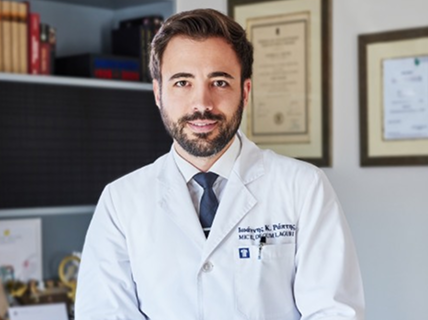
Ioannis Raptis has gained extensive clinical experience through his position as Senior Consultant at the German Perinatal Center AKH Hagen. There, he received comprehensive training in Special Obstetrics and Perinatal Medicine (Spezielle Geburtshilfe und Perinatal Medizin) and specialized in the management of high-risk pregnancies and complicated deliveries.
Doctor’s CV >>
Follow us

The increase in the average age of childbearing among women has become a well-established reality in recent years.
As a result, an increasing number of women choose to postpone motherhood until after the age of 40 for personal, social, or financial reasons. Although female fertility naturally declines with age and pregnancy after 40 is considered a high-risk pregnancy, advances in assisted reproductive technologies, together with modern prenatal monitoring and diagnostic methods, have made it possible for more women in this age group to achieve pregnancy and give birth safely.

After the age of 35–36, the chances of achieving a natural conception decline rapidly. For example, while a 35-year-old woman trying to conceive naturally has approximately a 70% chance of becoming pregnant within one year, this rate decreases to around 30% by the age of 40 and to approximately 15% by the age of 42. This decline occurs because both the number and the quality of a woman’s eggs diminish over time, making fertilization increasingly difficult.
In this context, in vitro fertilization (IVF) can improve the likelihood of achieving pregnancy, although its success rates also decrease with advancing maternal age. Indicatively, the success rate of IVF is estimated to be around 70% at the age of 35, whereas it declines to approximately 40% by the age of 40. This significant reduction in success rates is primarily attributed to the marked increase in chromosomally abnormal embryos associated with the aging of the oocytes.
Pregnancy after the age of 40 is considered a high-risk pregnancy, as it is associated with an increased likelihood of developing certain maternal and fetal complications. The most common risks include:


Over the last few decades, the field of assisted reproduction has advanced significantly, transforming the prospects of parenthood for women of advanced reproductive age. These developments have enabled an increasing number of women over the age of 40 to successfully achieve pregnancy and have a child.
In this context, in vitro fertilization (IVF), combined with innovations such as artificial intelligence and preimplantation genetic testing, has played a pivotal role. These technologies allow for the assessment of the embryo’s genetic material before embryo transfer, facilitating the detection of chromosomal abnormalities and certain genetic disorders.
The selection of chromosomally normal embryos significantly improves the likelihood of a successful IVF outcome and, ultimately, the birth of a healthy child.
Furthermore, in cases where ovarian reserve has been severely diminished due to age and conception with a woman’s own eggs is no longer feasible, IVF using donor eggs offers an effective alternative. Egg donation can provide high success rates, reaching up to 75%, regardless of the recipient’s age.
Because pregnancy after the age of 40 is considered high-risk, regular and specialized prenatal care throughout pregnancy is of paramount importance. Comprehensive prenatal monitoring is primarily focused on two key areas.
The first involves the thorough assessment of the fetus for potential genetic or chromosomal abnormalities. In this context, particular emphasis is placed on the following examinations:
The second focuses on the early detection and close monitoring of complications that may arise during pregnancy. Particular attention is given to conditions such as:
Early diagnosis and appropriate management of these conditions are essential to ensuring the best possible outcome for both mother and baby.

Pregnancy after the age of 40 presents unique medical challenges, both in terms of achieving conception and ensuring appropriate prenatal care throughout gestation.
In this setting, choosing an experienced reproductive specialist and obstetrician is of paramount importance. The physician’s scientific expertise, the multidisciplinary support provided by healthcare professionals from other specialties, as well as the comprehensive preparation and psychological support offered to the couple by an experienced midwife, are key components in ensuring safe and individualized care throughout pregnancy.
For specialized guidance and support regarding assisted reproduction and high-risk pregnancy, the doctor and his team are available to provide personalized care at every stage of your journey. Please do not hesitate to contact us for further information or to schedule a consultation.

Χρησιμοποιούμε cookies για να βελτιώσουμε την εμπειρία σας στον ιστότοπό μας. Χρησιμοποιώντας τον ιστότοπό μας, συναινείτε στη χρήση cookies.
Manage your cookie preferences below:
Essential cookies enable basic functions and are necessary for the proper function of the website.