
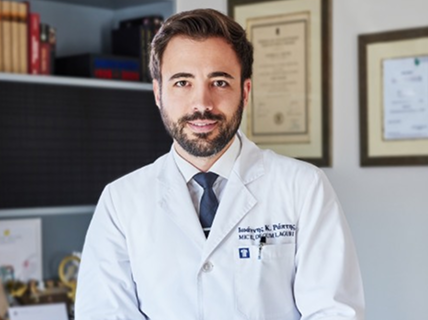
At the practice of Ioannis Raptis, infertility issues are managed in accordance with the guidelines of the “Frankfurt Hormone School” (Frankfurter Hormonschule) and the International Society of Gynecological Endocrinology (ISGE).
Ακολουθήστε μας

In vitro fertilization (IVF) is the cornerstone of assisted reproductive techniques, providing an effective solution for couples who are unable to conceive due to infertility problems.
The method relies on utilizing the woman’s ovarian egg reserves, which means its effectiveness decreases when these reserves are depleted.
In such cases, IVF with donor eggs represents a realistic alternative option with high success rates. During the procedure, eggs are retrieved from an anonymous donor. After laboratory preparation and fertilization with either the recipient’s partner’s sperm or donor sperm, embryos are created and then transferred into the recipient’s uterus with the aim of achieving pregnancy.
The entire process takes place within a strictly regulated legal framework that ensures complete anonymity between donor and recipient, as well as specific medical selection criteria (young age, good overall health, exclusion of transmissible and hereditary diseases, etc.) for women who wish to become donors.
IVF with donor eggs is an excellent option for women who:
Due to their age (usually over 43 years old), have a very low chance of achieving pregnancy through conventional IVF.
Despite being of younger age, do not have a sufficient number or quality of eggs, often due to premature menopause, multiple previous ovarian surgeries, a history of chemotherapy or radiotherapy, genetic syndromes, or other causes.
Have undergone multiple IVF attempts using their own eggs without success.


IVF with donor eggs differs from conventional IVF mainly in that the eggs used for fertilization come from an anonymous donor rather than from the recipient herself. As a result, ovarian stimulation and egg retrieval are performed on the donor, while the recipient undergoes preparation of the endometrium to receive the embryos.
IVF with donor eggs is an excellent option for women who:
Due to their age (usually over 43 years old), have a very low chance of achieving pregnancy through conventional IVF.
Despite being of younger age, do not have a sufficient number or quality of eggs, often due to premature menopause, multiple previous ovarian surgeries, a history of chemotherapy or radiotherapy, genetic syndromes, or other causes.
Have undergone multiple IVF attempts using their own eggs without success.
Infertility issues are managed in accordance with the guidelines of the “Frankfurt Hormone School” (Frankfurter Hormonschule).
The success rates of our practice (pregnancy with confirmed positive fetal heartbeat), officially reported to the Hygeia IVF Embryogenesis Clinic, are above both the international and Greek averages.
We exclusively perform transfers of day 5 or day 6 embryos (blastocysts). This approach allows for natural selection, reducing the likelihood of transferring embryos with genetic abnormalities and low implantation potential.
We also guarantee the provision of at least two morphologically high-quality blastocysts per donor egg IVF attempt.

There are many reasons why a woman may need donor eggs in order to achieve pregnancy. The most common are related to advanced maternal age, diminished ovarian reserve, premature ovarian insufficiency, and repeated unsuccessful IVF attempts.
The selection of the donor is always carried out by a medical team, under the strict supervision of the National Authority of Medically Assisted Reproduction. The regulatory framework applied in Greece is among the strictest internationally.
Donors undergo extensive genetic and biochemical testing, screening for infectious diseases, as well as psychological evaluation. Depending on availability, external characteristics are also taken into consideration in order to achieve compatibility with the recipient’s features.
Egg donation is strictly confidential and completely anonymous. Under no circumstances are the intended parents allowed to know the identity of the donor, and vice versa. However, recipients have the right to be informed about the donor’s external characteristics. Additionally, the medical team ensures the highest possible compatibility between the recipient’s and the donor’s physical characteristics.
The eggs come from healthy young women who choose to undergo the process either out of altruism or in exchange for compensation. In other words, the donor typically wishes to help couples have children, while financial compensation is provided to cover the cost of medical treatment, travel expenses, and loss of income due to participation in the procedure.
Although there is no genetic link between the recipient and the child, the selection of the donor’s external characteristics, epigenetic factors, and the child’s upbringing can significantly enhance resemblance.
In other words, factors such as the uterine environment can meaningfully influence gene expression in the child, while upbringing, facial expressions, and habits further strengthen the sense of similarity.
The success rates of IVF with donor eggs are higher than those of IVF using a woman’s own eggs within the population for whom the procedure is indicated.
The fact that the eggs come from young women, with better quality and quantity of genetic material, significantly increases the chances of success, with rates approaching 70–80%.
